

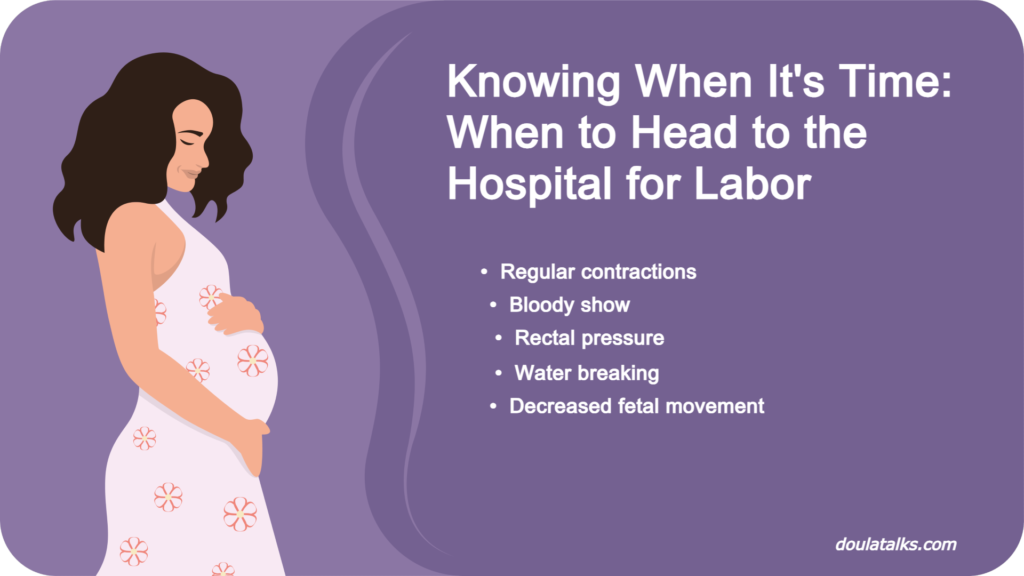
Knowing When It’s Time: When to Head to the Hospital for Labor
Epidural: What It Is, Procedure, Risks & Side Effects Rupture Of Membranes (Water Breaking) I’m a Doula: This Is What a Doula Does Pitocin: What It Is, Procedure, Risks & Side Effects Pain Management During Labor VBAC (Vaginal Birth After Cesarean) Induced Labor Natural Ways to Manage Labor Contractions Breech Baby Preparing a Birth Preferences Document (Birth Plan) Knowing When It’s Time: When to Head to the Hospital for Labor “But how will I know when to go?” “What if I get there too early/too late?”I get these questions A LOT!There seems to be a lot of stress surrounding this decision, and it actually IS an important decision — one that may determine the course of the labor from that point on. By Liat Salomon, doula February 27, 2024 Share on In This Article: Regular contractions Water breaking Heavy bleeding Rectal pressure Decreased fetal movement Other symptoms Going to the hospital too early may cause contractions to subside and space out. Lights, noises, stress of changing location, and an unfamiliar environment — all may cause your brain to produce more adrenaline, which will interfere with the production of oxytocin, the hormone responsible for contractions. Another effect may be that your pain level will increase due to the rising stress level and not being able to maintain the “oxytocin bubble” that also helps manage pain. The concern is that if contractions start spacing out and your pain level rises, it will lead to medical interventions, which might not have been necessary had you stayed laboring at home and arrived at the hospital later when the effect of the location change on the labor process would be minimal. When I say medical interventions, this could include different types of inductions or the use of pain medications. The timing of when to go to the hospital for labor can depend on several factors, such as your pregnancy history, your obstetrician or midwife’s recommendations, your own preferences, and, of course, the labor progression. This can be a tricky decision. However, here are some general guidelines that can help you determine when it’s time to go to the hospital: Regular contractions Timing contractions One reason to head to the hospital is when you start having regular contractions that are getting stronger and closer together. If this is your first baby, using the popular 5-1-1 method (contractions – from the start of one to the start of the next – are 5 minutes apart, lasting for 1 minute, and have been this way for at least 1 hour) will get you to the hospital too early. The early labor stage for first babies is expected to be significantly longer, and with contractions at 5-1-1, you may still be in early labor and not in active labor. First baby Personally, I recommend that if this is your first baby, you should wait until contractions are 3-4 minutes apart (or 3 contractions in 10 minutes), each contraction about a minute long, and all of this has been going on for at least an hour to an hour and a half. Second baby and up For the second baby and up, a 4-1-1 method is OK to start heading to the hospital. Also Read: Epidural: what it is, procedure, risks & side effects Natural ways to manage labor contractions Water breaking If you have been having good, frequent contractions and your water broke, it’s time to go to the hospital. Please note that if your water broke and it is clear but you are not having any contractions, you can stay home, rest, and wait for them to start. For a more in-depth look at water breaking, check out my article “Rupture of membranes (water breaking)”. Heavy bleeding If you experience heavy vaginal bleeding, it may be a sign of a problem with the placenta, so it’s important to seek medical attention right away. Please note that it is normal to have “bloody shows”, a discharge type with blood in it. It is not just normal but an actual sign of progress, and you should expect to see it, in growing amounts, until you give birth. Rectal pressure As labor progresses and the baby is descending and pushing more and more on your cervix, we expect dilation to increase and the baby to get lower in your pelvis. At some point, you can expect to start feeling a “pooping” sensation in your rectum. At first, you will feel it only during a contraction and not very strongly, but at some point, it will get stronger and more present. Later it will stay even after the contraction is over. This is a good sign to head to the hospital. Decreased fetal movement If you notice a decrease in your baby’s movement or you don’t feel any movement for a few hours, call your healthcare provider or go to the hospital immediately. Other symptoms If you experience other symptoms like severe, sharp abdominal pain, fever, or vomiting, it’s important to contact your healthcare provider or go to the hospital. There is one more thing to consider when trying to decide about going to the hospital. I like to call it the “I can’t take it anymore meter”. We use the term “can’t take it” very often and very loosely, even if we do not really mean it or absolutely can take it. I recommend that if you say, “I can’t take this anymore”, you will have someone around you ask two questions: Are you sure? What is it exactly that you can’t take anymore? The first question is to see if it is one of those cases where we say it but don’t mean it. For example, making you think about it may result in agreeing to revisit it again in an hour. The second one is even more important: if you can’t take the pain and wish to go in to get an epidural, that’s one thing, but if you want to go in because you are curious to
Knowing When It’s Time: When to Head to the Hospital for Labor Read More »