

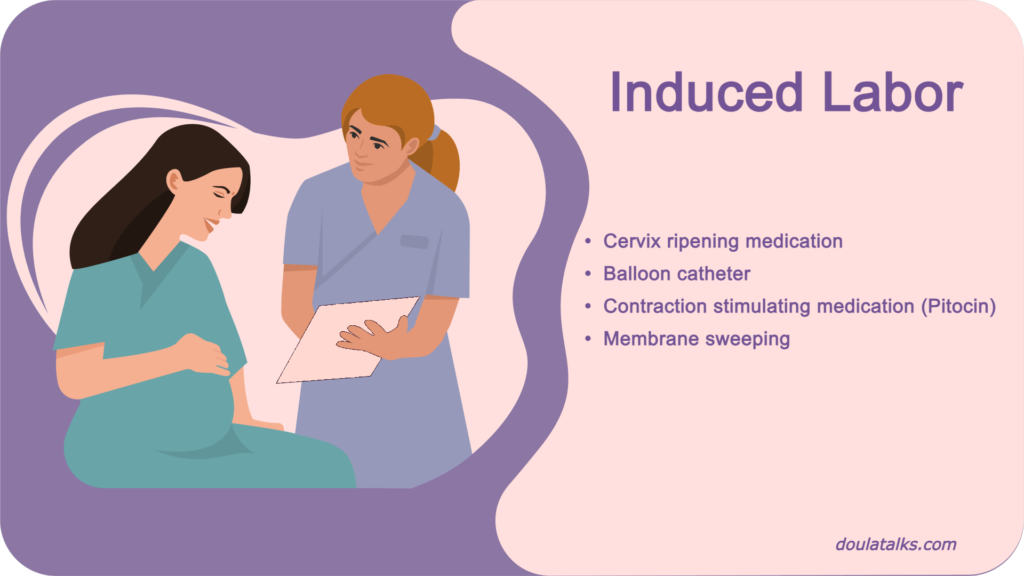
induced labor

Induced Labor

labor induction procedure explained to a pregnant woman by a healthcare provider

Knowing When It’s Time: When to Head to the Hospital for Labor Pitocin: What It Is, Procedure, Risks & Side Effects Rupture Of Membranes (Water Breaking) I’m a Doula: This Is What a Doula Does Epidural: What It Is, Procedure, Risks & Side Effects VBAC (Vaginal Birth After Cesarean) Pain Management During Labor Breech Baby Natural Ways to Manage Labor Contractions Preparing a Birth Preferences Document (Birth Plan) Induced Labor In the U.S., it is very common for health providers to offer an induction at 39 or 40 weeks. There are some medical conditions that require it, but oftentimes the recommendations have to do with outdated protocols or convenience reasons—and are not justified. By Liat Salomon, doula February 27, 2024 Share on In This Article: Labor induction methods How painful is induced labor? Does the cervix have to be dilated before starting an induction? How long does it take from induction to labor, and how long will it take to give birth? What happens if you don’t dilate after being induced? What are the risks for mom and baby of inducing labor? How many inductions end in C-sections? When should you not get induced? When do you ask for an epidural during induction? How to prepare for labor induction How to make labor induction easier Can you walk around after being induced? Can you sleep during induced labor? How to induce labor naturally How long do you stay in the hospital after an induced birth? When I moved to California I thought that my days talking about excessive inductions were over. Boy, was I wrong…. I was blown away by the staggering number of inductions done here! Labor induction is the process of artificially starting labor in a pregnant woman. This may be done for a variety of reasons, including if the woman is past her due date, if there are concerns about the health of the mother or baby, or if the woman has a medical condition that makes continuing the pregnancy risky. In the past few years, there’s been an increase in the number of inductions being performed. There are multiple reasons for it, but the bottom line is that there are too many inductions being done—with no real medical reason—due to a protocol that does not look at someone’s actual condition and only takes into consideration a generic birthing person. One common reason for labor induction is if the birthing person is past their due date. Pregnancy is typically considered full-term at 37 weeks, but the average length of pregnancy is actually closer to 41 weeks. In fact, statistically, first-time babies are born at 41+5. Another reason for labor induction is a health concern for either the baby or the mother. For example, if the baby is not growing as expected or if the mother has a medical condition such as high blood pressure or liver issues, it could potentially put her and/or the baby at risk if the pregnancy continues. In addition, certain medical conditions can make continuing the pregnancy risky for the mother, such as pre-eclampsia, placental abruption, or placental insufficiency. In these cases, inducing labor may be necessary to protect the mother’s health. Labor induction methods Several methods can be used to induce labor. One common method is to use medication to stimulate contractions. This can be done using oxytocin, a hormone that naturally occurs in the body and helps to stimulate contractions, with the medication Pitocin or through the use of prostaglandins (such as misoprostol), which are hormones that help to soften and thin the cervix. The choice of method will depend on various factors such as the woman’s health condition, the baby’s health, and the stage of pregnancy. Here are some other common methods used for inducing labor: Membrane sweeping This is a procedure in which a healthcare provider will use their fingers to sweep around the cervix, separating the amniotic sac from the cervix. This can help release hormones (prostaglandins) that may start contractions and initiate labor. Balloon catheter This method involves inserting a small balloon catheter into the cervix to help it dilate and soften, which can help trigger contractions. Breaking the water A healthcare provider can manually break the amniotic sac (which contains the fluid surrounding the baby) using a special tool. This can stimulate the release of hormones (prostaglandins) that may start contractions and initiate labor.For further information on water breaking, you can read my article: “Rupture of membranes (water breaking)“. I will say that breaking the water is my least favorite form of induction. I feel that it starts a whole new set of protocols and is not reversible. Also, after the water is broken, you can expect contractions to get a lot more intense—right from the start—instead of building gradually. It’s important to note that all of these methods carry some risks, and induction should only be considered and done when medically necessary! Also Read: Pain management during labor Epidural: what it is, procedure, risks & side effects How painful is induced labor? Induced labor can be more painful than spontaneous labor as the body is being forced into labor before it’s fully ready. The intensity of the pain can vary depending on the woman’s pain tolerance and the methods used for induction. The contractions experienced during induced labor can be more intense and frequent, and may feel different than natural contractions.It’s important to have emotional support from partners, family members, and healthcare providers, as this can help manage anxiety and stress during labor and delivery. Does the cervix have to be dilated before starting an induction? The only induction method that requires dilation is membrane sweeping (stripping).Other forms of induction do not require a certain dilation to begin, and some of them, like a catheter, are intended to start dilation. How long does it take from induction to labor, and how long will it take to give birth? The time it takes from induction to the start of active labor can vary depending on

Induced Labor Read More »

Pitocin: What It Is, Procedure, Risks & Side Effects

Pregnant woman receiving Pitocin through IV during labor

I’m a Doula: This Is What a Doula Does Natural Ways to Manage Labor Contractions Induced Labor Pain Management During Labor Knowing When It’s Time: When to Head to the Hospital for Labor Preparing a Birth Preferences Document (Birth Plan) Rupture Of Membranes (Water Breaking) VBAC (Vaginal Birth After Cesarean) Epidural: What It Is, Procedure, Risks & Side Effects Pitocin: What It Is, Procedure, Risks & Side Effects By Liat Salomon, doula February 27, 2024 Share on In This Article: Oxytocin and its role in labor induction The right time to use Pitocin Administration and dosage of Pitocin Does Pitocin affect dilation? Will I be able to rest while receiving Pitocin? How to manage pain while on Pitocin Understanding the risks: common side effects of Pitocin for mom and baby Does the use of Pitocin increase the risk of a C-section? Boosting your oxytocin: tips and techniques for increasing hormone levels naturally Conclusion In the last few years, there has been a significant rise in labor induction rates in the U.S. The medical community happily adopted the ARRIVE trial without questioning it, and doctors began recommending induction to a growing number of women at 39-40 weeks pregnant, regardless of the subjective medical situation. Some medical conditions indeed require medical intervention. However, an induction is a tool that is best used in moderation and only when absolutely needed. There are different methods or medications that are used to induce labor. This article will review the use of Pitocin. Pitocin has had a very bad reputation over the years. I feel that recently, as it became more and more clear what the best ways to use Pitocin are, it became safer, can allow more control over the process, and, when used correctly and for the right reasons, it is a good tool to have. Oxytocin and its role in labor induction Pitocin is a synthetic form of the hormone oxytocin, which is naturally produced by the body. Oxytocin is also known as the “love hormone” and is involved in various physiological processes, including stimulation of contractions in the uterus during labor and the release of breast milk. The mechanism of action of Pitocin is like that of the natural oxytocin hormone. It acts on the uterine smooth muscle to cause rhythmic contractions, to either start labor artificially or to augment slow or irregular contractions. The right time to use Pitocin For best results, Pitocin should only be used when it is determined that the cervix is ripe and ready. The cervix must be soft enough to allow contractions to be effective and, in turn, get the cervix to shorten, which will then cause it to open (dilate). If the cervix is not ready, there might be a need to offer prostaglandins (either vaginally with Cervidil, or orally with Misoprostol/Zitotec). Also Read: Induced labor I’m a doula: this is what a doula does Administration and dosage of Pitocin Pitocin is typically administered intravenously (IV) through an IV line inserted into a vein in the arm. It is delivered continuously through an infusion pump, which is carefully monitored to ensure the correct dosage is delivered. The dosage of Pitocin depends on several factors, including the woman’s gestational age, the stage of labor, the strength and frequency of contractions, and the health of the baby. In general, the initial dosage of Pitocin is low and is gradually increased until the desired effect is achieved. The half-life of oxytocin in the bloodstream is about 3 to 5 minutes, meaning that it is rapidly metabolized and eliminated from the body. Does Pitocin affect dilation? Pitocin can help stimulate uterine contractions and facilitate dilation of the cervix during labor. However, the rate at which dilation occurs varies and can depend on several factors, including the woman’s previous pregnancy history, her age, and the position of the baby. In general, dilation of the cervix typically occurs gradually over the course of several hours to a few days. The average time it takes to progress from 1 cm to 10 cm of dilation is usually between 6 to 20 hours, although this can vary widely and can be shorter or longer depending on the individual woman and the specific circumstances of her labor. It is important to note that while Pitocin can help to speed up the dilation process, it can also increase the risk of certain complications, such as uterine hyperstimulation or fetal distress. Will I be able to rest while receiving Pitocin? The purpose of using Pitocin is to help labor progress, and just like with spontaneous or natural contractions, we hope that at some point the contractions are intense enough to promote labor. In that case, sleeping or even lying down will not be comfortable. I always suggest getting as much rest before labor really kicks in, and usually, when Pitocin levels are low, it is still possible. When it gets uncomfortable to rest, you can start walking around the room, get on all fours in bed, sit on a birthing ball, and even use a shower (the nurse can cover the IV tubes). How to manage pain while on Pitocin Pain during labor and delivery is a subjective experience, and women may experience pain differently. The pain associated with Pitocin-induced contractions can vary from woman to woman. Although Pitocin-induced contractions can be stronger and more frequent than natural contractions, it may also depend on several factors including individual pain tolerance, the stage of labor, and the strength and frequency of the contractions. Same as with natural contractions, you can choose to use pain management techniques, such as breathing exercises, massage, shower/bath, and pain medication. Understanding the risks: common side effects of Pitocin for mom and baby Pitocin is a commonly used medication, but like all medications, it has associated risks and side effects. Some of the most common risks and side effects of Pitocin include: Uterine hyperstimulation Pitocin can cause the uterus to contract too strongly or too frequently, which can lead to uterine hyperstimulation and

Pitocin: What It Is, Procedure, Risks & Side Effects Read More »